Table of Contents
ToggleIn the contemporary dynamic digital world, organizations are raising more questions, such as What is DevSecOps and why it matters today? The solution is in the fact that DevSecOps integrates development, security, and operations, which makes security a part and parcel of the software lifecycle and not just a post-factum. This proactive strategy enables teams to be quicker and not risk omitting protection. With the rise in the sophistication of cyber threats, DevSecOps has become a requirement, and not an option, to build resilience and trust.
This guide will discuss the fundamental ideas of DevSecOps, its working process, the differences, and the outline of an average DevSecOps pipeline, which will give a new insight into why the given approach is necessary in 2025.
By the end, you will understand how DevSecOps helps teams to make secure and efficient innovations.
Learn more about essential tools in our guide on DevOps Tools.
Understanding DevSecOps
In the simplest terms, DevSecOps incorporates security throughout all the phases of the software development life cycle. DevSecOps also makes sure that vulnerabilities are identified early and continuously, as opposed to the traditional model that has security checks at the end.
Key characteristics of modern DevSecOps:
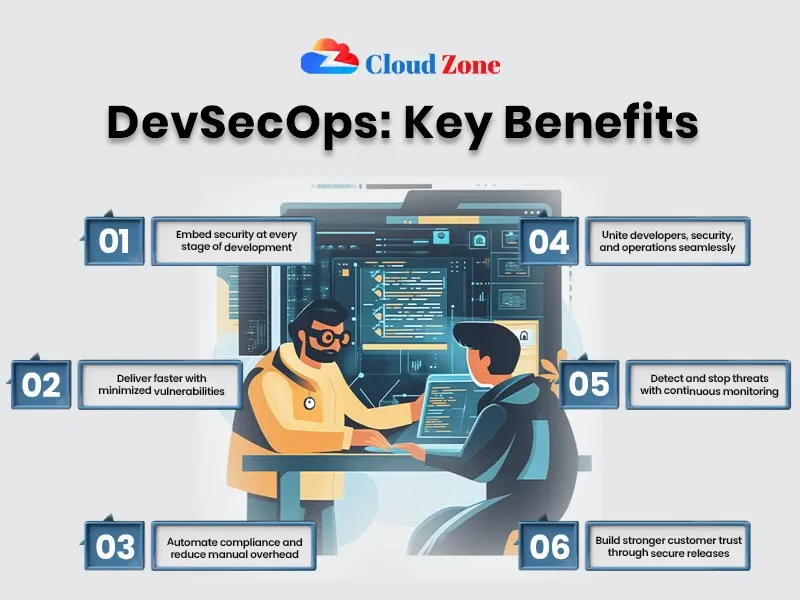
- Continuous Security Monitoring: Automated tools scan for vulnerabilities at every stage of development.
- Collaboration among Teams: There is a smooth working relationship between the developers, security professionals, and operations.
- Automated Compliance: Security policies and regulatory requirements are implemented auto-magically.
- Shift-Left Security Approach: The security shifts left during the development process and minimizes the risk and rework.
Basically, DevSecOps is more of a mindset than a methodology that puts an emphasis on the proactive approach to security rather than a reactive remedy.
Build a strong technical base with AWS Certification Training.
The DevSecOps Methodology: What is DevSecOps Methodology?
What is DevSecOps methodology?
It is a formal mechanism to instill security in software development. In contrast to manual checks, new DevSecOps practices are based on automation, collaboration, and feedback to deliver secure software.
Core Components of DevSecOps Methodology:
- Continuous Integration/Delivery(CI/CD): CI/CD pipelines are made to incorporate security tests.
- Automated Threat Modeling: A.I. systems detect possible attacks to the system in design and development.
- Infrastructure as Code Security: Automated checks are scans that ensure that cloud and infrastructure settings are secure.
- Security Awareness & Culture: Team members are all trained to detect risks and pursue safe coding methods.
Such an approach will allow companies to minimize risk exposure, expedite delivery, and enhance the development process in line with the objectives of enterprise security.
Master container management through Azure Kubernetes Service.
Understand secure coding and DevOps security automation strategies.
What is DevSecOps vs DevOps: Key Differences
Many organizations ask what is the difference between DevOps and DevSecOps, or what is DevSecOps vs DevOps. While DevOps focuses on speed, efficiency, and collaboration between development and operations, DevSecOps adds security as a shared responsibility across the pipeline.
| Aspect | DevOps | DevSecOps |
| Focus | Development + Operations | Development + Security + Operations |
| Security | Often handled separately at the end | Embedded throughout the lifecycle |
| Risk | Vulnerabilities may be discovered late | Continuous monitoring and proactive mitigation |
| Compliance | Manual audits | Automated compliance and policy enforcement |
In short, DevSecOps is an evolved version of DevOps that ensures security isn’t compromised for speed.
Explore modern Cloud-Native Application Development.
The DevSecOps Pipeline: What is DevSecOps Pipeline?
Consider it a safe CI/CD process, in which each phase will have security checks.
Stages of a Modern DevSecOps Pipeline:
- Planning & Requirements: Find security requirements and function specs.
- Coding & Commit: Automate code scanners to identify vulnerabilities in real time.
- Build & Integration: In the CI/CD cycle, security testing is to be carried out to avoid problems.
- Testing: Add dynamic application security testing (DAST) and penetration testing.
- Deployment: Hardened infrastructure is a requirement, and deployment scripts should be based on best practices.
- Monitoring & Feedback: Be a vigilant watchman to the team and report back.
This pipeline ensures that security is continuous, automated, and embedded in development, rather than an afterthought.
Understand server infrastructure with What is a Dedicated Server.
What is DevSecOps and Why It Matters Today?
DevSecOps is increasingly becoming more relevant in 2025 owing to:
- Gaining Cyber Threats: There is a growing threat surface with cloud adoption, remote work, and IoT.
- Regulatory Pressure: Firms should adhere to tougher security and privacy laws all over the world.
- Reduced Delivery Times: Agile and DevOps teams simply cannot afford delays incurred by late-stage security fixes.
It is important to note that customers are worried about their data security: any breach of the rules is a bad sign that affects the brand image immediately.
The modern DevSecOps makes sure that businesses are able to deliver software fast and at the same time be highly secure, which is a non-negotiable requirement today.
Advance your AI expertise with Amazon Machine Learning Courses.
Modern Trends
DevSecOps continues to develop. There are some emerging trends, which are:
- AI-Powered Security Analytics: Intelligent tools that forecast and identify anomalous activity before it transitions into a real threat.
- Zero Trust Integration: The application of the principles of never trust, always verify at all steps of the pipeline.
- Serverless Security: Automatically attach protection to serverless functions as they are being developed.
- Security-As-Code: Code security checks so they can be tested, tracked, and enhanced over time.
- DevSecOps in Hybrid & Multi-Cloud: Keeping security consistent across different cloud platforms and on-prem systems.
- Robots to Check Compliance: This involves automating methods of ensuring that apps and systems invariably comply with rules and regulations in terms of security.
- Shift-Left Security: Security testing earlier in the development cycle, such that bugs are identified and remedied more quickly.
- Continuous Monitoring: Monitoring of systems on the fly to detect and react to threats as they happen.
These tendencies turn DevSecOps not only into a methodology but an opportunity in the competition of progressive organizations.
Start your cloud journey with Azure Fundamentals.
Learn DevSecOps practices aligned with industry certification standards
Implementing DevSecOps Successfully
DevSecOps methodology implementation needs a strategy, tools, and cultural alignment.
Steps for Success:
- Develop a Security-First Culture: Educate developers and operations on how to code and be aware of threats.
- Automate Security Testing: Add automated vulnerability scanners to CI/CD pipelines.
- Adopt DevSecOps Tools: Use tools for code analysis, container security, cloud security, and monitoring.
- Measure & Iterate: Trace the important metrics like the mean time to detect (MTTD) and the mean time to remediate (MTTR).
- Ongoing Co-operation: The security teams should also work hand in hand with developers and operations at every step.
These steps will enable organizations to strike the right balance between speed, agility, and security.
Learn essential storage management in our Complete Guide to OneDrive.
How DevSecOps Could Transform Your Software in the Future
Adopting the DevSecOps approach nowadays is not only about closing the existing security vulnerabilities, but also about changing the paradigm of how software is developed, deployed, and supported in the future.
Future Impacts of DevSecOps:
- Proactive Risk Management: Software is going to isolate vulnerable areas and will counter them automatically in the future before they can affect users.
- Shorter Innovation Times: Teams can release features more quickly since they do not have to worry about breaches because security is built in.
- Smart Software Behavior: Intelligent software behavior might enable dynamically responding software to threats, in an AI-led DevSecOps pipeline.
- Increased Customer Confidence: Future users will demand software that is by default secure and compliant, which will enhance brand loyalty.
- Continuity of compliance: Regulations are bound to become stricter, and automation of security will make software compliant with international standards.
- Through DevSecOps, organisations will have the ability to future-proof their software, making it secure, reliable, and able to handle the changing cyber threats and customer demands.
Boost your skills using AWS Skill Builder.
Conclusion
In 2025, DevSecOps is more than a buzzword; it’s a necessity for any organization delivering software in a fast-moving, threat-prone environment.
Understanding what is DevSecOps and why it matters today, the methodology, the difference between DevOps and DevSecOps, and the pipeline will equip teams to deliver secure, reliable, and compliant software faster.
Strengthen your automation knowledge with Azure DevOps CI/CD Pipelines.
Ready to put security at the heart of your software development?
The future of security is DevSecOps, which is why you should adopt it today to change how your teams build, test, and deliver.
Automation of pipelines, integrating security throughout its lifecycle, and making it part of your culture where everybody is charged with protecting it will not only help you stop the current cyber-attacks. It will also help you have the courage to continue innovating.
Explore DevOps Training in Chandigarh or check DevOps Course Pricing to build a resilient DevSecOps strategy that works.

Sukhamrit Kaur
Sukhamrit Kaur is an SEO writer who loves simplifying complex topics. She has helped companies like Data World, DataCamp, and Rask AI create engaging and informative content for their audiences. You can connect with her on LinkedIn.