Table of Contents
ToggleIn the current dynamic software development world, producing high-quality applications in a short time frame is crucial. A step-by-step guide to understanding CI/CD pipelines can be used to explain the process, as CI/CD pipelines are used to build, test, and deploy software, allowing teams to release updates more consistently and with fewer failures.
This guide will describe the principles of continuous integration and continuous delivery, explaining how they simplify software development and deployment. It will also walk you through the layout of a modern pipeline, dividing each step into easy-to-follow, straightforward steps.
Through this step-by-step guide to understanding CI/CD pipelines, both new and experienced developers will be better equipped to understand automation in software delivery. Ultimately, the goal is to help teams make faster, higher-quality releases and gain confidence in each release.
Build a strong foundation with Azure Fundamentals.
What is CI/CD?
First, let’s understand the basics. What is CI CD?
CI/CD is Continuous Integration and Continuous Delivery (or Continuous Deployment). With this in mind, teams automate integration, testing, and deployment practices, reduce human error, and speed up development cycles.
• Continuous Integration (CI): Even, developers submit code to a shared repository, then automated builds and tests catch errors early.
• Continuous Delivery (CD): With this in mind, teams keep the code deployable, so they deploy to production with minimal human intervention.
To put it simply, what is CI and CD? CI is about safe and fast integration, and CD is about providing reliable software to users regularly.
Learn cloud storage essentials in this complete guide to OneDrive.
Master CI/CD Pipelines automation for enterprise-level applications
Understanding What is CI/CD Pipeline
What is CI/CD pipeline?
A CI/CD pipeline is an automated workflow that orchestrates the steps of building, testing, and deploying software.
Key Stages of a CI/CD Pipeline:
Code Commit: Code developers submit their changes to a common repository (e.g., Git).
Automated Build: The system tools together the code and produce executable files.
Automated Testing: Unit tests, integration tests, and other tests are executed to identify early problems.
Deployment: The software is automatically deployed to the staging or production environment.
Monitoring & Feedback: The pipeline monitors the application after deployment and provides developers with feedback on how to improve.
Thus, what is a CI CD pipeline? It’s a completely automated process that turns new code into a deployable product safely and efficiently.
Explore cloud learning with AWS Skill Builder.
Benefits of CI/CD Pipelines
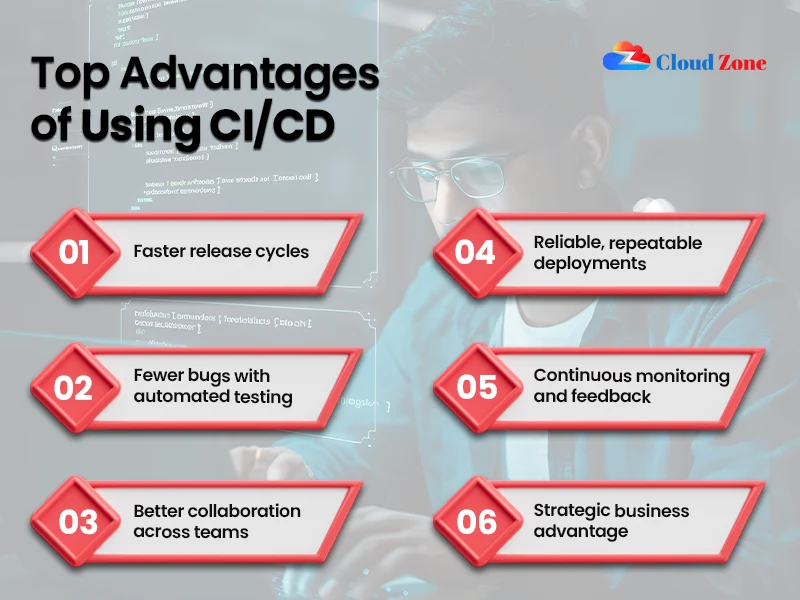
Implementing a CI/CD pipeline offers several advantages:
Quick Release Cycles: Releases are made faster for the user.
Fewer Bugs: Bugs are detected by automated testing before they are introduced to production.
Better Cooperation: Developers can cooperate without integration problems.
Credible Deployments: Consistency and repeatability: Automated processes will guarantee similar outcomes.
Continuous Feedback: With post-deployment monitoring, it is possible to have the teams iterate, learn, and apply.
Businesses that adapt CI/CD pipelines in 2025 will be at the forefront to provide fast and reliable software to gain a competitive advantage.
Master automation with Azure DevOps CI/CD Pipelines.
Step-By-Step Guide to Understanding CI/CD Pipelines
Here’s a practical guide to building a modern CI/CD pipeline:
Plan Your Pipeline
• Define objectives: faster delivery, better testing, or deployment automation.
• Identify code repository, testing, and deployment tools and platforms.
Version Control Integration
• Through systems such as Git, deal with code.
• Further, ensure every team member follows branching strategies to keep integration smooth.
Automated Build Setup Example:
• Configure the pipeline to compile the code every time an individual commits his/her code.
• Include static code analysis for early detection of errors.
Automated Testing
• Implement unit tests, integration tests, and security tests.
• With this in mind, we will automate tests to save time and reduce human error.
Deployment Automation
• Automatic deployment of code to staging.
• Automate, where needed, the deployment approval gates in the case of production releases.
Monitoring and Feedback
• Performance, mistakes, and user experience monitoring tools.
• Feed insights back into the development process for continuous improvement.
Stay updated on industry growth, read about AWS’s $2 Billion Investment in Indian Data Centers. Understand the differences between DevOps and Agile.
CI/CD Best Practices
To maximize the efficiency of your CI/CD pipeline, follow these best practices:
- Commit Often: The fewer and more frequent the commits, the fewer the conflicts.
- Automate All: With this in mind, automate builds, tests, and deployments to reduce human error and speed up delivery.
- Use Feature Flags: Deploy new features without impacting all of the users.
- Monitor and Log: Be observant to identify and solve problems fast.
- Start Small, Scale Gradually: Begin with critical projects and expand CI/CD across teams.
Begin your journey with AWS Training for Non-Tech Professionals.
Learn CI/CD Pipelines and earn recognized DevOps certification.
Common Misconceptions About CI/CD
- CI/CD needs to be used by Large Teams: Even small teams can use automated pipelines.
- Automation Supplants Developers: CI/CD does not eliminate developers; it makes them more productive.
- CD Always Means Continuous Deployment: However, teams can automate Continuous Delivery (CD) to deploy to staging instead of production.
Strengthen your cloud security knowledge with AWS Security Training.
How CI/CD Could Change Your Software in the Future
Looking ahead, adopting CI/CD pipelines will transform software development in several ways:
- Predictive Issue Resolution: AI will detect possible bugs and eliminate them during the deployment.
- Instant Rollbacks: Pipelines will auto-roll back malfunctioning releases in seconds.
- Self-Healing Systems: CI/CD pipelines might initiate remedial activity on their own.
- Intensified Security: With this in mind, DevSecOps integrates security testing into CI/CD pipelines.
- Quickened Innovation: The teams can experiment, test, and introduce new features faster than before.
Adoption of CI/CD lets companies get ready for a new era of quicker, more secure, and clever software delivery.
Prepare for global certification through AWS Certification Training.
The Role of CI/CD in Business Today
enhance the quality of a product, and react to market changes promptly.
Key Business Benefits of CI/CD:
- Accelerated Time-to-Market: Swifter release cycles imply that business entities can release new features or products to the market, ahead of their competitors.
- Better Customer Experience: There are constantly new updates, which make companies fix bugs and seamlessly add features, leaving users satisfied.
- Efficiency in Operation: Automation eliminates errors in the manual process and liberates teams to engage in strategic work.
- Risk Mitigation: Small updates that occur with high frequency minimize the possibility of mass failures in production.
- Data-Driven Decisions: CI/CD pipelines are allowing analytics on performance and deployment success of code, to assist leaders in making informed decisions.
The incorporation of CI/CD into operations gives enterprises a competitive advantage, making software delivery a source of innovation and development.

Things to Keep in Mind While Implementing CI/CD
Implementing a CI/CD pipeline is transformative, but doing it effectively requires careful planning and best practices.
Key Considerations:
- Start Small, Scale Gradually: Begin with a single project or team and expand as the process stabilizes.
- Select the Appropriate Tools: Select CI/CD platforms that harmonize with your current infrastructure.
- Emphasize Testing: With this in mind, automate testing as much as possible to catch mistakes early.
- Enforce Security: Embed security testing into the pipeline (DevSecOps) to avert vulnerabilities.
- Monitor and Iterate: Continuously Improve: use metrics such as deployment frequency, lead time, and failure rate.
- Train Your Team: Make sure every developer and operations personnel know pipeline operations and best practices.
Get hands-on experience with Azure Kubernetes Service.
Conclusion
In conclusion, a step-by-step guide to understanding CI/CD pipelines, what is CI CD, what is CI and CD, what is CI/CD pipeline, and what is a CI CD pipeline are no longer optional concepts; they are essential for modern software development. A properly managed CI/CD pipeline minimizes errors, shortens the delivery time, and sustains continuous improvement; thus, it is one of the primary sources of business success in 2025.
Ready to streamline your software development process? Start implementing a CI/CD pipeline today. Automate builds, tests, and deployments, and watch your development cycles become faster, safer, and more efficient.
Learn to build scalable systems through Cloud-Native Application Development.

Sukhamrit Kaur
Sukhamrit Kaur is an SEO writer who loves simplifying complex topics. She has helped companies like Data World, DataCamp, and Rask AI create engaging and informative content for their audiences. You can connect with her on LinkedIn.