Table of Contents
ToggleIntroduction
In the modern digital era, protecting personal information is still a necessary thing. Understanding General Data Protection Regulation Basics informs about the fact that the GDPR provides individuals with the choice regarding what data they provide, and businesses have to be responsible in managing the information. By either being the head of a multinational company or a small business, you need to be aware of what is the GDPR and why it is important.
This article describes the nature of GDPR, defines GDPR regulations, and demonstrates how companies can become compliant with GDPR.
By the end of the article, you are bound to be in the know of the GDPR meaning, the principles on which its application should be made, and the reasons why privacy protection enhances trust.
What is GDPR?
The General Data Protection Regulation (GDPR) is a law in the European Union that has enhanced the protection and the rights of privacy.
- It provides explicit guidelines on how personal information should be gathered, stored, and shared.
- It applies to any organisation that deals with the data of EU residents, regardless of the place.
- The companies should be transparent and acquire a valid consent.
- Users are entitled to access, fix, or erase their information.
Concisely, what does GDPR stand for? It is an acronym of empowering individuals and making organizations responsible for privacy.
With the rise of cloud infrastructure, AWS investing an additional $2 billion in Indian data centers shows how data compliance and privacy, like GDPR remain a priority.
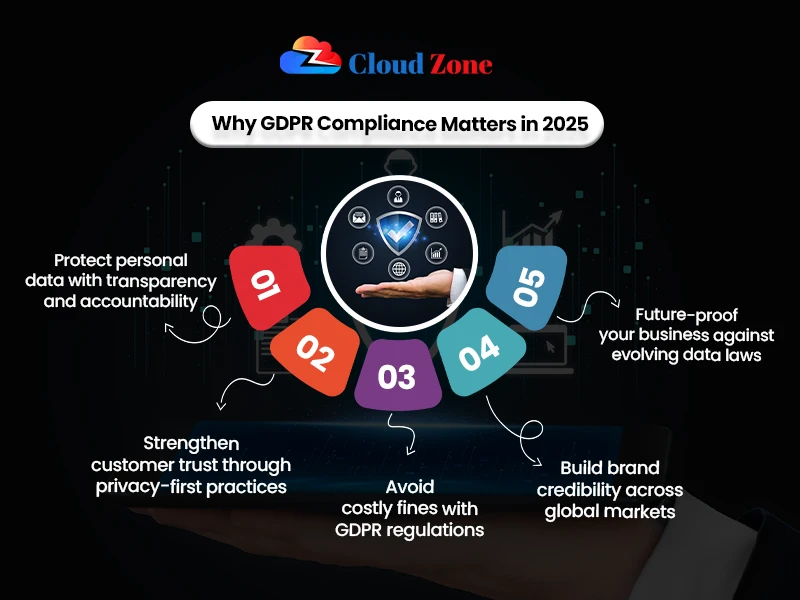
Core Principles of GDPR Compliance
GDPR compliance demands that there are certain principles of legal processing be followed by businesses. The regulation emphasizes transparency, data minimization, purpose limitation, and integrity. Organizations should only fairly process data, and they should store only what they require.
They should not only update data to make it accurate, but also secure it against security breaches. Following these rules, businesses do not infringe upon individual rights and demonstrate the willingness to comply with what is GDPR compliance. These values actively protect organizations from fines and also, therefore, build strong long-term trust. High compliance also enhances effective data governance and efficiency.
For secure file sharing and storage aligned with GDPR, businesses often explore OneDrive to manage user data.
Rights of Individuals Under GDPR
- Entitlement to understand the purpose and method of usage of personal data by companies.
- Right to have access to personal information at any time.
- Right to correct the mistakes by rectification.
- Right to erase information by the right to forget.
- Right to disobey or limit the processing operations.
- Freedom to transfer information via portability.
Protect user data and meet GDPR requirements with expert compliance guidance.
What Are the GDPR Regulations?
The GDPR regulations stipulate responsibilities that all organizations should follow. Businesses should be ready to create systems that are privacy-conscious and ensure that they have documentation of data processing. They must carry out Data Protection Impact Assessments (DPIAs) on high-risk operations and may have to designate a Data Protection Officer.
Violations should be notified within 72 hours of the violation, and the penalty can be up to 20 million euros or 4 percent of worldwide turnover. With compliance with these requirements, organizations will fulfill the expectations of GDPR what, and they will demonstrate how they are prepared for global privacy standards.
Just like GDPR requires transparency and monitoring, telemetry helps track and analyze data for compliance.
Understanding GDPR Meaning in Simple Terms
The GDPR meaning is not limited to the legal regulations; it is a cultural change in the area of privacy. Businesses are concerned about trust and accountability by understanding what is the GDPR. They promote the safe management of data, lower the risk of abuse, and enhance efficiency.
Firms that share such a mentality not only escape punishment but also demonstrate their concern about ethical operations. The focus on the meaning assists organizations in establishing better relations with customers. Application of these principles will make data protection a normal routine in the business.
Companies adopting hybrid cloud strategies must ensure GDPR regulations are respected across environments.
Ensure lawful data handling practices while building trust with customers globally.
Steps to Ensure GDPR Compliance
To get to compliance, practical steps can be followed by the organization:
- Conduct audits to find out the personal data and processing risks.
- Encrypt and have tight control.
- Further, we clearly establish privacy policies, and moreover, we actively obtain informed consent from all participants.
- Educate the staff about the principles of GDPR and safe measures.
- Periodically upgrade to enhance the systems of security.
These measures guarantee organizations what is GDPR compliance and respect personal rights.
Monitoring solutions such as Amazon CloudWatch align well with GDPR’s requirements for auditing and reporting.
Challenges in Implementing GDPR
There is actual difficulty in the implementation of GDPR compliance in businesses. The combination of the old systems and the new rules, international transfer rules, third-party vendors, and managing them is the aspect that can be difficult to achieve.
Firstly, smaller companies often lack resources; however, large enterprises must actively coordinate across multiple departments. Addressing these challenges, companies enforce the real meaning and enforce their privacy structure.
A strong DevOps culture supports GDPR by ensuring security and compliance are integrated into processes.
Benefits of Following GDPR
Adhering to GDPR has many advantages:
- Establishes consumer loyalty and trust.
- Enhances brand image using transparency.
- Eliminates threats of violations and abuse.
- Enhances the practices of data management.
- Favors expansion in the foreign market.
- Companies that adhere to these rules demonstrate that they respect what does GDPR stand for in the current digital economy.
Specialized AWS security training helps teams build GDPR-compliant architectures.
Future of Privacy and GDPR
Understanding General Data Protection Regulation Basics is the key to the future of privacy. The emergence of AI, IoT, and cloud services makes the safety of personal data even more important. Companies aware of what are the GDPR regulations can embrace the emerging challenges fast. Not only does this offer protection to data nowadays, but its adherence also lays down the groundwork for future laws of privacy across the globe.
Comparing Azure vs AWS vs Google Cloud is useful when selecting GDPR-ready platforms.
Evaluating Your Organization’s GDPR Readiness
Therefore, organizations should regularly review their systems and also update controls to prevent risks.
- Compare the policies with their requirements.
- Determine compliance lapses and correct them.
- Train staff consistently.
- Supervise suppliers of Third Parties.
- Develop rapid response measures to data breaches.
Such analysis demonstrates that there is an admiration towards GDPR what and that businesses never lag.

Conclusion
Understanding General Data Protection Regulation Basics is important to businesses in any industry. When organizations follow GDPR rules, they therefore gain trust and safeguard sensitive information effectively. Adhering to the meaning of GDPR and what does GDPR stand for will help keep the companies transparent, responsible, and secure.
Organizations that proactively apply any of the principles of this mitigate the chance of data breaches and enhance customer loyalty. Also, by recording consistency in compliance, the businesses will be ahead of others in ethical data management and privacy protection.
Learners can enhance compliance knowledge by joining top cloud computing institutes in Chandigarh for cloud and data protection training.
Begin by enhancing your privacy. Get to know more about GDPR compliance, learn what is the GDPR, and implement the actions of Understanding General Data Protection Regulation Basics. Be data protective, safeguard user privacy, and be accountable in all decisions.

Sukhamrit Kaur
Sukhamrit Kaur is an SEO writer who loves simplifying complex topics. She has helped companies like Data World, DataCamp, and Rask AI create engaging and informative content for their audiences. You can connect with her on LinkedIn.