Table of Contents
ToggleDo you want to create scalable, maintainable, and testable software?
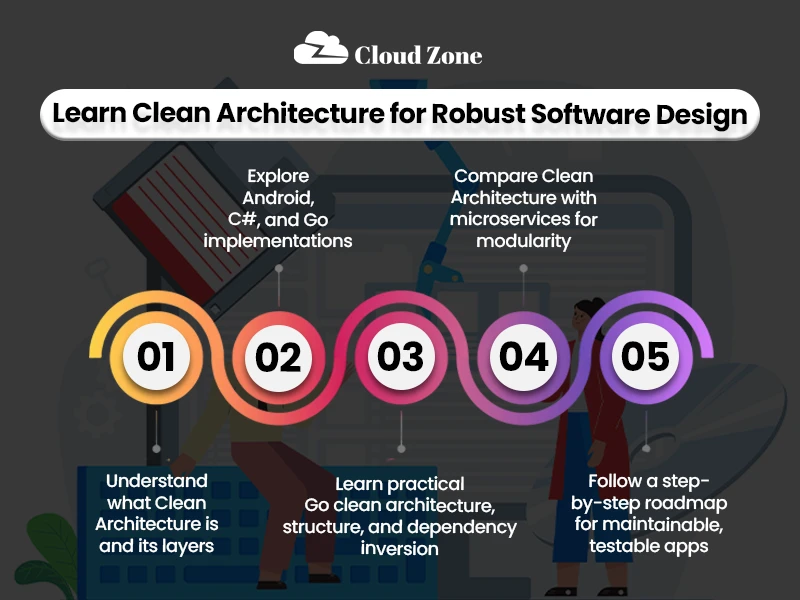
This article will teach you about the Clean Architecture Roadmap, what is the clean architecture, is clean architecture worth it, what is Clean Architecture Android and C# implementation, and get some insights into the real-life structures and practical benefits. Therefore, this roadmap is not merely a theory but assists you in adopting Clean Architecture efficiently.
You will also understand how to organize your projects using Go Clean Architecture structure, dependency inversion to modularity, Clean Architecture versus microservices, and a step-by-step
adoption roadmap that leads to maintainable and testable applications. Also, you will walk away with practical strategies on how to develop software that can be more easily scaled, extended, and maintained in the long term.
For specialized cloud expertise and certifications, start with AWS Certification Training – Amazon Web Services
Understanding Clean Architecture
Clean Architecture divides software into layers that isolate business rules under structures, UI, and databases.
The key layers include:
Entities: Business core objects.
Use Cases / Interactors: Application specifics of orchestrating entities.
Interface Adapters: Translate information in external systems into entities.
Frameworks & Drivers: UI, databases, web structures, and outside services.
Hence, maintaining the clean architecture C# principles means that the Developers must always direct dependencies inward, such that the UI and database must not tie to the business logic. Besides, this simplifies testing, makes them more maintainable, and enables frameworks to evolve without impacting core logic.
Build and automate deployment workflows by exploring Learn Azure DevOps CI/CD Pipelines
Clean Architecture in Android
Firstly, to implement what is Clean Architecture Android will mean organizing your application in such a way that it has clear layers, such as ViewModel, Repository, Use Cases, and Entities. Then, dependency inversion enables Use Cases injection in ViewModels, which retains the UI logic in Activities or Fragments, whereas the business rules stay in Use Cases. Additionally, repositories user interfaces over data sources like Room databases or Retrofit APIs, and the fundamental logic is not tied to any external framework.
Enhance your AWS learning journey with insights from What is AWS Skill Builder.
Also, LiveData or StateFlow: LiveData or StateFlow allows reactive update of Views to Use Cases to maintain the UI in sync with the application state. The process of testing also occurs with less difficulty because you can easily mock repositories and verify Use Cases independently. Above all, with these principles, your Android app will scale with grace as new features are developed and remain maintainable and testable.
Improve file sharing and collaboration by reviewing the Complete Guide to OneDrive.
Design maintainable software structures that simplify development, testing, and long-term system growth.
Go Clean Architecture Structure
Go projects benefit from clear folder separation:
- /cmd for application entry points.
- /internal for core business logic, such as entities and use cases.
- /pkg for reusable library and component.
- /adapter for database HTTP, and messaging interface adapter.
- /config to configure files and set up dependency injection.
- /scripts to build scripts or migration scripts.
Lastly, using go clean architecture structure helps teams maintain clarity, improve collaboration, and reduce coupling between modules.
Understand modern development practices with DevOps vs Agile: Understanding Key Differences
What is Clean Architecture C# Implementation
- Firstly, plain old CLR objects (POCOs) are found in the entities layer in C#.
- Secondly, the application layer has Use Cases that coordinate business rules.
- Thirdly, the infrastructure layer, repositories, database access, and external services are implemented.
- Also, the Presentation layer contains either MVC or MVVM, Windows Forms, WPF, or Blazor.
- Moreover, dependency injection can be used with defined .NET Core services to maintain loosely-coupled layers.
- Additionally, unit tests focus on Use Cases and Entities and separate business logic, the UI, and the database.
These what is clean architecture C# practices guarantee enterprise-grade maintainability or testability.
Difference Between Microservices and Clean Architecture
Clean Architecture focuses on internal modularity, while microservices emphasize external service boundaries.
| Aspect | Microservices | Clean Architecture |
| Definition | Splits applications into deployable services | Splits layers in a single application. |
| Focus | Service-level decomposition and distributed systems. | Layered design, dependency inversion, and internal modularity. |
| Deployment | Teams can deploy each service separately | Usually, a single application deployment. |
| Internal Patterns | Can apply Clean Architecture patterns to each service | Gives structure and testability of modules. |
| Benefits | Scalability, independent updates, and team independence. | Testability, maintainability, and separation of concerns. |
| When to Use | When it is required that the system scale in a distributed manner, or that it requires independent updates of services in the system. | When it is necessary to have clean, testable, and decoupled code in an application. |
| Combination | A combination is possible for both modular and distributed systems. | It can be used within micro services to structure internally. |
Understanding what is the difference between microservice and clean architecture helps teams select the right pattern for their projects.
Is Clean Architecture Worth It?
- Lessens technical debt by separating core logic and frameworks.
- Makes it easier to add new features by simplifying the maintenance. Yet, makes testing more reliable and quicker.
- The system supports multiple interfaces (web, mobile, and APIs) without duplicating business logic.
- Promotes reusability of the parts of projects.
- Scales better in the long term, particularly with enterprise-level systems.
Is clean architecture worth it? Yes, because investing time at the outset results in maintainable and adaptable applications.
Stay informed about career opportunities by checking out GCP Salaries 2025 in India
Ensure scalability, testability, and clarity in modern software systems using proven architecture principles.
Practical Tips for Android Developers
The strategies to be applied to implement what is clean architecture Android are as follows:
- Make ViewModels uncomplicated and relocate the business logic to Use Cases.
- Cover up the data source with Repository interfaces.
- Connect Use Cases to LiveData or Flow Use Cases are updated reactively by connecting them to LiveData or Flow.
- Write Unit Tests for Use Cases and Entities without considering the UI.
- Use such tools as Dagger Hilt or Koin to manage interdependence among layers.
These are some of the practices that are maintainable, scalable, and do not fall into the usual Android traps.
Roadmap for Clean Architecture Adoption
The first step towards the Clean Architecture Roadmap is the separation of Entities and business rules from the UI in order to make core logic independent of interface code. Secondly, Add Use Cases to coordinate application logic and Add Repository interfaces to data sources in an abstract way. Use dependency injection in order to reverse dependencies on business rules and loosely coupled layers.
Progressively rewrite existing code into substitutable defined layers in a manner that does not disrupt the functionality, and keep on writing unit tests to verify the correctness of Use
Cases and Entities. By following this roadmap, teams can embrace Clean Architecture in stages and in a realistic way that enhances maintainability, testability, and scalability with ease, without affecting the development process too much.
Master modern container management through Mastering Azure Kubernetes Service.
Combining Clean Architecture with Microservices
What is Clean Architecture C# can be used within every microservice to maintain clean code, modular code, and testable code. Services continue to be developed and deployed independently, and communicate with each other via APIs or events, and remain simple to update and observe without becoming mini-monoliths. In each service, this process ensures that developers isolate business logic from infrastructure. It also makes sure that CI/CD checks secure core rules throughout the system.
Knowing what is the difference between microservice and clean architecture in this case will make sure you use the best of both worlds.
Conclusion
Embracing the Clean Architecture Roadmap concepts enhances the software longevity, testability, and flexibility. Therefore, with systematic layers, dependency inversion, and separation of business rules and frameworks, developers are able to have high-quality systems. Regardless of clean architecture C# or Go-based structures, the principles are the same.
Strengthen your backend development skills by learning How to Connect to Database in Java.
Get your Clean Architecture started.
Refactor a small module, layer, and have easier to test, maintain, and scalable software that passes the test of time.

Sukhamrit Kaur
Sukhamrit Kaur is an SEO writer who loves simplifying complex topics. She has helped companies like Data World, DataCamp, and Rask AI create engaging and informative content for their audiences. You can connect with her on LinkedIn.