Table of Contents
ToggleIntroduction
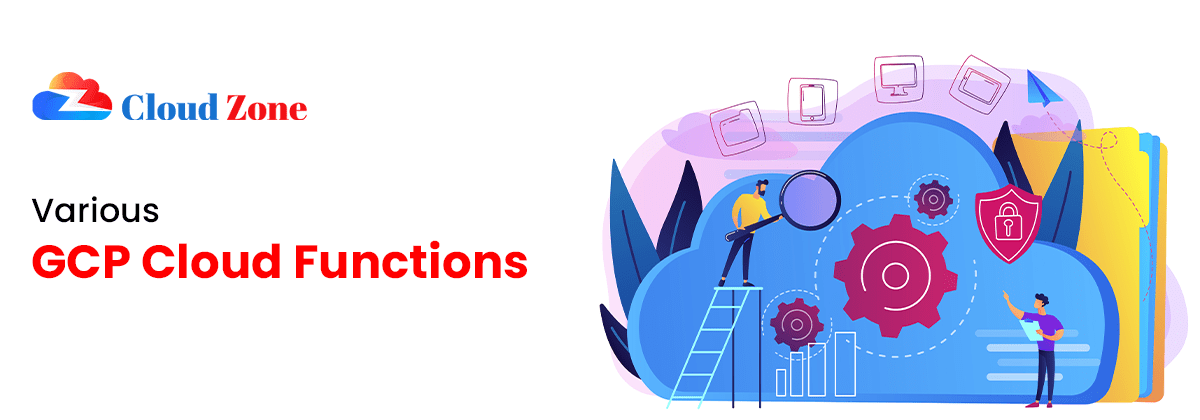
When teams move workloads to the cloud, they seek speed, scalability, and cost efficiency. Precisely, that is offered by Various GCP Cloud Functions, which offer serverless computing that is fast to deploy and manage. Therefore, the developers do not have to worry about the underlying infrastructure; Google takes care of it.
This is because, to create modern applications that seamlessly scale, one must understand what is GCP Cloud Functions. Cloud functions GCP simplify the process of achieving faster time-to-market, whether through automating workflows or with data processing.
Scale and migrate workloads confidently with guidance from cloud migration strategies when using GCP Cloud Functions in enterprise scenarios.
Why Various GCP Cloud Functions Matter
These enable programmers to execute code without configuring servers. These are scaled and event-driven functions that are automatically managed and tightly coupled with other Google Cloud services.
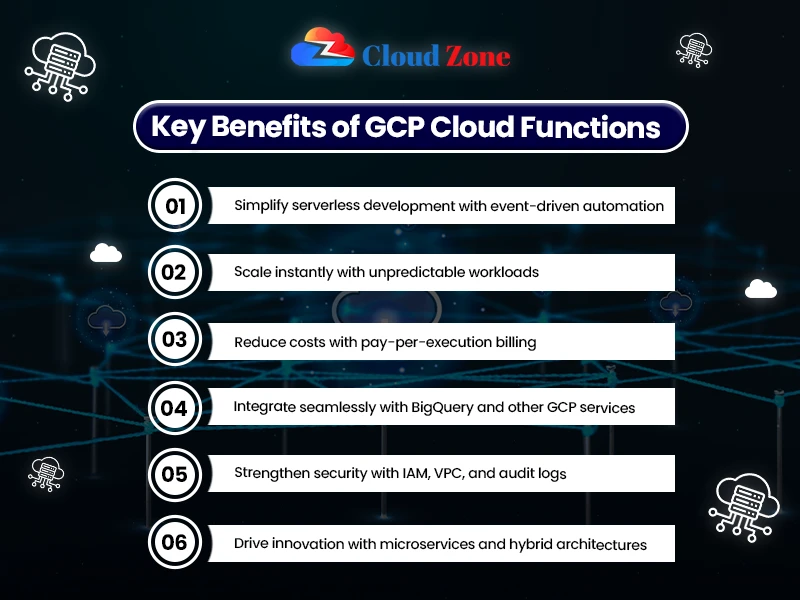
- Automate the execution of actions when files are uploaded into the database or the database is changed.
- Elasticity Scale up quickly to match erratic demand.
- Only pay by execution time and not by reserved capacity.
- Integrate easily with Big Query GCP and GCP functions to enhance smooth operations.
Understanding what is cloud function in GCP, teams are able to reduce overhead in operations and concentrate on development.
For a broader understanding of DevOps roles that often use serverless functions like GCP Cloud Functions, see what is DevOps engineer.
Exploring GCP Functions in Action
There are a number of GCP Cloud Functions that can be implemented in a number of real-world scenarios. They allow the developers to write minimal code that responds to events, enhancing the efficiency of cloud services.
- Scaling of images when they are uploaded by the users.
- On-the-fly notifications upon any change to a Firestore document.
- Checking of data before recording it in databases.
- Programmed backups based on the scheduled occurrences.
Knowledge on how to create a cloud function in GCP assists software developers in automating such activities and interacting with cloud functions GCP.
Explore what is agentic AI to see how intelligent automation can complement cloud functions in modern applications.
Master cloud automation, triggers, and APIs using GCP Cloud Functions.
What is Cloud Function in GCP
What is cloud function in GCP? It is an event-driven, lightweight, serverless code. They automatically scale, patch, and monitor, unlike traditional applications.
- Minimizes the complexity of deployment.
- Concentrates developer energy on server administration, not reasonable to write code.
- Many supported programming languages.
- Easy to deal with parallel requests.
Through the knowledge of what is GCP cloud functions, teams will be able to utilize serverless computing to offer microservices and event-based designs.
Monitor and analyze data effectively alongside GCP Cloud Functions by learning about telemetry practices.
Comparing AWS Lambda vs GCP Cloud Functions
Numerous companies compare AWS Lambda vs GCP Cloud Functions to find out which of the two serverless systems best suits their requirements. Although the two are both event-driven, pricing, ecosystem, and integration differences are important.
AWS has a wider regional coverage, and GCP is more closely integrated with other services, such as BigQuery GCP. The per-invocation billing model of GCP can be used to advantage workloads that cannot be predicted. Learning about cloud functions and AWS Lambda can guide enterprises to maximize strategies revolving around clouds.
For hybrid architectures that combine on-prem and cloud systems, check hybrid cloud strategies compatible with serverless workloads.
Steps on How to Create a Cloud Function in GCP
Understanding how to create a cloud function in GCP enables developers to implement serverless solutions within a short period of time.
- The Google Cloud Console is opened, and one navigates to Cloud Functions.
- Select runtime options and click on Create Function.
- Write or paste your code in the editor.
- Identify a trigger, e.g., HTTP request or Pub/Sub event.
- Install and debug at the command line.
These steps are made easier by GCP Cloud Function, which allows scaling applications and connecting them for faster results.
Integrate your cloud monitoring using Amazon CloudWatch for insights, even if you operate in multi-cloud setups.
Integrating with Big Query GCP
The combination of Big Query GCP enables organizations to run the data pipelines automatically. Serverless functions have the potential to process, clean, and insert data in close real-time, eliminating human work and enhancing consistency.
- Preprocess the received streams of information and then insert them into BigQuery.
- Clean up activities that occur periodically.
- New data is inserted into the anomaly triggered.
- Automatically transfer the results to dashboards.
Combining the services of cloud functions GCP with this guarantees the maintenance of analytics without human intervention.
Learn how to foster a collaborative and productive DevOps culture to maximize the benefits of GCP Cloud Functions in your team.
Build event-driven cloud solutions using GCP Cloud Functions and APIs.
Advanced Security for Various GCP Cloud Functions
Working with these requires security. The use of best practices makes the data safe and guarantees the achievement of compliance requirements.
- Limit roles with the help of IAM principles.
- Secrecy of environment variables.
- Install private communication VPC connectors.
- Observation of access using Cloud Audit Logs.
GCP functions are scalable with security policies; therefore, organizations can safely apply serverless applications by integrating them and security policies.
Compare cloud ecosystems with Azure vs AWS vs Google Cloud to understand why GCP Cloud Functions may fit your workload.
Designing Long-Term Architectures with Cloud Functions GCP
Scalable and flexible architectures may be based on various Cloud Functions. They are optimal in terms of microservices, hybrid applications, as well as event-driven designs.
- Chain contend with pipelines of intricate workflows.
- Introduce CI/CD continuous delivery.
- Combine containerized loads to deploy hybrids.
- To monitor all transactions, adopt event sourcing.
The long-term maintainability and scalability of GCP are strategic with the use of cloud functions.
Explore training and opportunities with women in cloud Azure training opportunities to enhance cloud skills relevant to serverless functions.
Scaling Beyond Basics in Cloud Functions
Various Cloud Functions have a real opportunity in enterprises. Teams are able to build resilience and workflows, use AI services, and bring observability across systems, to name a few.
- Monitoring expansion of Cloud Operations.
- Use multi-region to implement greater availability.
- Add AI APIs to add functionality.
- Uniformity in logging and tracing to minimize the troubleshooting time.
The use of these in conjunction with Big Query GCP is both performance and insight-scaled.
Understand cloud-native architectures for mobile-first applications through mobile cloud computing architecture.
Conclusion
Various GCP Cloud Functions allow organizations to accelerate development, reduce costs, and automate processes. Understanding what is GCP Cloud functions, and integrating with BigQuery GCP transforms workflows into strategic advantages. By comparing AWS Lambda vs GCP Cloud Functions, teams can choose the right tool for their event-driven applications.
Start experimenting with Cloud Functions today to unlock the full potential of serverless architecture.
If your environment runs Linux, see how Ubuntu cloud computing works alongside serverless services.
Start building with Various GCP Cloud Functions today! Create your first GCP Cloud Function and experience how these can automate workflows, enhance scalability, and drive innovation.
Ensure your serverless workloads are backed up with cloud backup solutions to prevent data loss.

Sukhamrit Kaur
Sukhamrit Kaur is an SEO writer who loves simplifying complex topics. She has helped companies like Data World, DataCamp, and Rask AI create engaging and informative content for their audiences. You can connect with her on LinkedIn.